
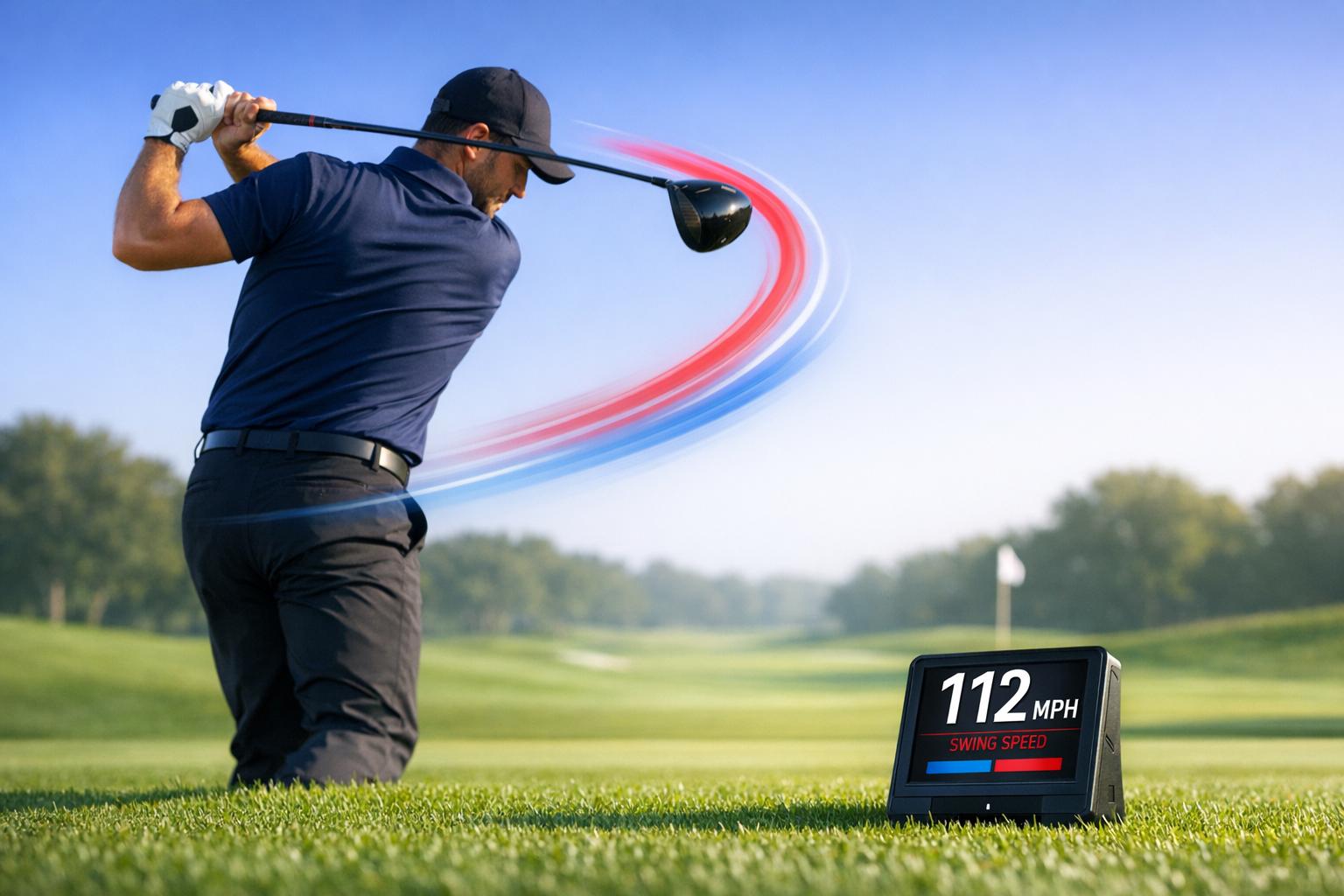
Swing speed is one of the most important factors in golf. It directly impacts how far you can hit the ball, what equipment suits you best, and how you approach the course. Here’s why it matters:
- Distance: Every 1 mph increase in swing speed adds about 2.4 yards to your shot. Faster swing speeds translate to more carry distance.
- Equipment: Your swing speed determines the right shaft flex for your clubs. For example, slower speeds need more flexible shafts for better performance.
- Strategy: Players with higher swing speeds can take more aggressive lines, while others need to focus on precision and control.
To measure and improve swing speed, tools like launch monitors or swing radars can help. Training methods, including overspeed drills, strength exercises, and flexibility routines, can lead to noticeable gains. However, balance is key – focusing only on speed without control can hurt your accuracy.
Whether you’re a beginner or an advanced player, understanding your swing speed and tailoring your approach can improve your game.
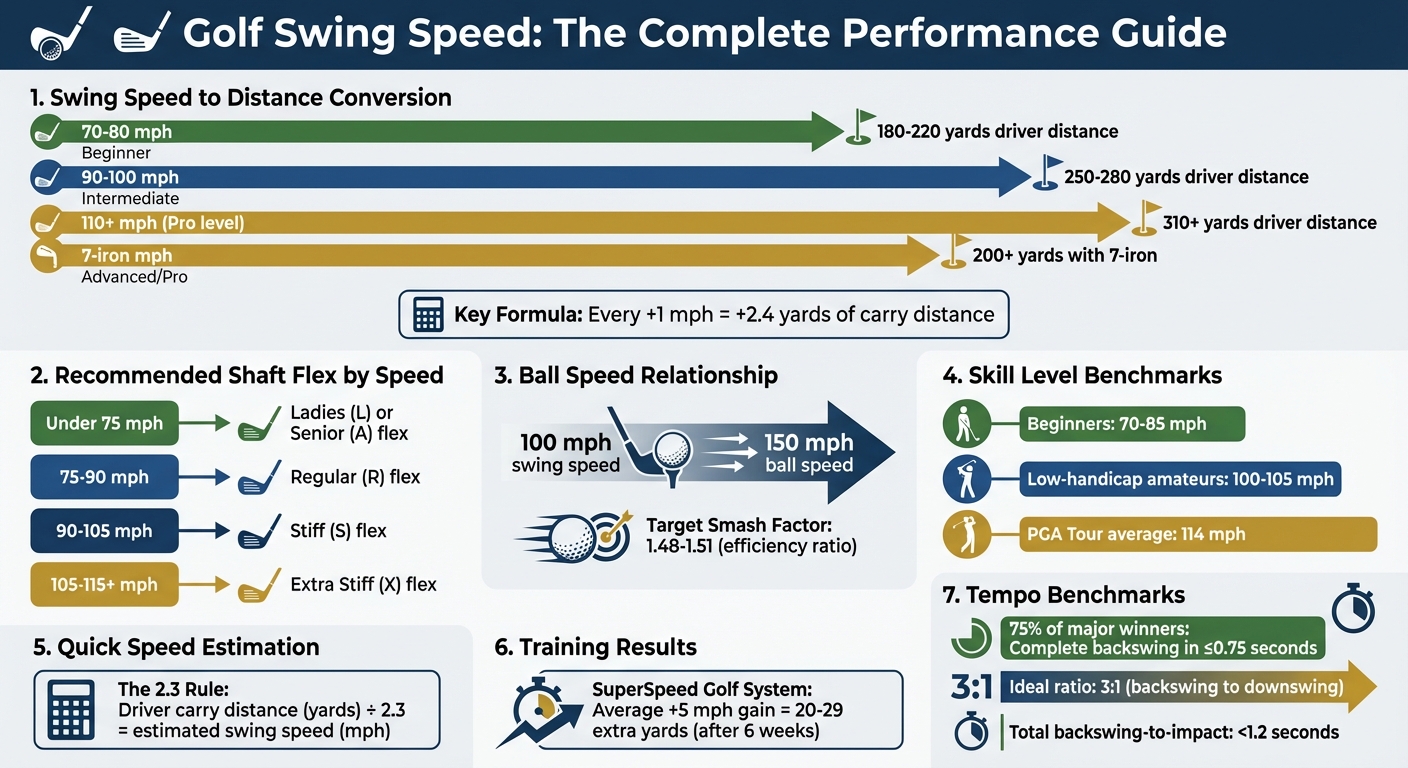
Golf Swing Speed Chart: Distance, Equipment, and Performance by Speed Range
Improve your Golf SWING Speed | Achieving a Single Figure Handicap | Padraig Harrington
How Swing Speed Affects Your Golf Game
Swing speed plays a crucial role in every part of your golf game. It affects how far you hit the ball, the clubs you choose for different shots, and even your strategy for navigating hazards on the course. Whether you’re aiming for distance or precision, understanding your swing speed can make all the difference.
Swing Speed and Shot Distance
The faster your swing, the farther the ball can travel. As Performance Golf explains, "The faster you can swing a club, the easier it is to create ball speed and total distance". To put this into perspective, a swing speed of 100 mph generates around 150 mph of ball speed. Golfers with swing speeds between 70 and 80 mph typically drive the ball 180–220 yards. Increase that swing speed to 90–100 mph, and driver distances jump to 250–280 yards. Professional players, swinging at 110 mph or more, can drive the ball well over 310 yards and hit 7-irons beyond 200 yards.
This added distance provides a significant advantage. It allows players to use shorter, higher-lofted clubs, like wedges, for approach shots. These clubs offer better stopping power and precision on the greens. However, while distance is a key benefit of higher swing speeds, it also brings the challenge of maintaining accuracy.
Balancing Swing Speed with Shot Accuracy
While faster swings can add distance, they also increase the potential for mistakes. At higher speeds, even a slight mis-hit can result in a much wider miss compared to a slower swing. A Golf Digest robot test highlighted this: a 95 mph swing, when optimized, produced 250.5 total yards – outperforming a faster 105 mph swing by 5.5 yards. Drew Powell from Golf Digest summed it up well: "Swinging faster is not always the solution to hit the ball farther".
Professional golfer Andy Proudman of "Me and My Golf" demonstrated this concept during a 2026 session using a FlightScope Mevo+ launch monitor. While recovering from a wrist injury, Proudman reduced his swing intensity to about 50% of his usual speed. The result? His accuracy improved significantly, and his distance loss was minimal. This highlights the importance of finding the right balance between speed and control.
How Swing Speed Changes Your Course Strategy
Swing speed doesn’t just impact your shots – it also shapes your approach to the course. Golfers with swing speeds over 110 mph can afford to take aggressive lines, attacking hazards and reaching par 5 greens in two shots. Meanwhile, those swinging at 90 mph or below must adopt a more cautious approach, carefully avoiding carries they can’t clear.
Spencer Lanoue, Founder of Caddie AI, emphasizes the value of knowing your swing speed: "Knowing your numbers helps you set realistic expectations and separates a ‘good drive for you’ from a ‘mis-hit.’ It helps you move from wishful thinking to data-driven understanding". This knowledge can also help you adjust your strategy mid-round. For example, you might dial back your swing on narrow fairways or small greens, where precision matters most, and reserve your maximum effort for wide-open fairways or long par 5s.
Understanding and managing your swing speed allows you to play smarter and more effectively, turning raw power into a well-rounded game.
Measuring and Improving Your Swing Speed
Tools and Apps for Tracking Swing Speed
If you want to measure your swing speed accurately, choosing the right tool is the first step. Launch monitors, which rely on Doppler radar or high-speed cameras, track both club and ball motion. On the other hand, portable swing speed radars focus on measuring your clubhead speed near impact.
The price range for these tools varies widely. Basic radars start at under $150, while high-end, tour-level devices can exceed $25,000. For most amateur golfers, mid-range options like the Garmin R10 or Rapsodo MLM2PRO provide reliable data without breaking the bank. Another popular choice is the Sports Sensors Swing Radar Tempo Trainer, which excels in recording both speed and tempo consistency. If you’re looking for great value, the PRGR Black Pocket Launch Monitor – rated 4.3/5 – is a solid option, as it measures multiple parameters, including smash factor.
AI-powered apps are also making their mark in swing speed analysis. In April 2024, Golf.com editor Zephyr Melton tried the Sportsbox AI Speed Assessment feature to analyze his driver swing. The app measured his clubhead speed at 102 mph and identified a "maximum potential" of 106 mph. By using 3D motion data, it pinpointed "power leaks" in his pelvis lift and transition. The app suggested that by improving his hip bump and lead-side ground push, he could gain 4 mph in speed, translating to an additional 8 yards of carry distance.
Once you’ve gathered accurate data, the next step is turning those numbers into real performance improvements.
Training Methods to Increase Swing Speed
Boosting your swing speed requires a mix of targeted training methods. Overspeed training – using lighter clubs or alignment sticks – is a proven approach. Combine this with strength, core, and flexibility exercises like deadlifts, Russian twists, and medicine ball slams to build the power and mobility needed for faster swings.
The SuperSpeed Golf Training System, priced around $200, has gained over 1,000 five-star reviews. Users report an average increase of 5 mph in clubhead speed, resulting in 20–29 additional yards of carry distance after just six weeks of training. Professional golfer Padraig Harrington even calls it:
"the easiest way to gain speed"
For explosive power, incorporate medicine ball drills such as slams or wall throws using a 2–6 lb ball. These exercises focus on generating force through your arms and trunk. Once you’ve built strength, work on flexibility and tempo. Increasing shoulder and hip rotation can create a wider swing arc, giving you more time to generate speed. Effective stretches include torso rotations and standing forward bends.
The "Whoosh" Drill is a simple yet effective way to fine-tune your timing. Flip your driver upside down and swing the grip end, aiming to produce the loudest "whoosh" sound at or just past the point of impact. This ensures you’re releasing maximum speed at the right moment.
Tempo training is another key element. Research shows that 75% of the last 100 major championship winners completed their backswings in 0.75 seconds or less. A 3:1 ratio between your backswing and downswing times is ideal for maximizing force. The Speed Ladder Drill can help you develop this rhythm. Line up five balls and swing at 20% speed for the first, gradually increasing intensity with each ball until you reach 100% on the fifth – all while maintaining balance.
Mistakes to Avoid When Increasing Swing Speed
One of the biggest mistakes golfers make is prioritizing raw power over proper technique. Excessive grip pressure and muscle tension can actually slow you down. Aim for a grip pressure of 4 to 6 on a 1–10 scale and hold the club lightly in your fingers. Scott Shepard, a Golf Performance Coach, cautions against the "swing as hard as you can" mindset:
"The idea that you should just swing as hard as you can and throw out all technique is, in my opinion, one of the most dangerous ideas in modern speed instruction"
Stability is another critical factor. Without it, you’ll struggle to transfer speed and power effectively, leading to a loss in both distance and accuracy.
Another common error is poor power sequencing. If you release power too early – a mistake known as "casting" – you’ll generate maximum speed before reaching the ball, wasting energy. Many golfers also focus too much on strength training while neglecting flexibility. However, flexibility is essential for effective rotation and speed.
Using the wrong equipment can also hinder your progress. According to Swing Align:
"A shaft that is too stiff robs you of feel and timing. Remember, it is not always how fast you swing the club, it is how you swing it fast"
Lastly, avoid making your backswing too slow. Data shows that a dynamic, faster backswing helps generate more force for the downswing. In fact, most of the last 100 major winners completed their backswing-to-impact motion in less than 1.2 seconds.
Tailoring Swing Speed to Your Skill Level
Swing Speed Tips for Beginners
If you’re new to golf, your driver swing speed is probably somewhere between 70–85 mph. The goal is to find the fastest swing you can manage while still hitting the ball squarely on the clubface. A quick way to estimate your swing speed is by dividing your average driver carry distance (in yards) by 2.3.
One common mistake beginners make is trying to swing too hard, which creates tension. As Spencer Lanoue from Caddie AI explains:
"Tension is the enemy of speed. When you tighten your arms and shoulders, you sabotage your body’s ability to move freely and generate power through rotation".
To avoid this, focus on maintaining a light grip pressure – around 4 to 6 on a scale of 1 to 10. Stand with your feet slightly wider than shoulder-width, and start your downswing by shifting your weight into your lead foot while rotating your hips. This smooth motion helps you maximize speed and control. As a bonus, every additional 1 mph in swing speed adds about 2.4 yards to your shot.
Your choice of equipment also plays a big role. If your swing speed is under 75 mph, opt for a Ladies (L) or Senior (A) flex shaft. For speeds between 75–90 mph, a Regular (R) flex shaft is a better match. Once you’ve nailed the basics, you’ll be ready to start refining your technique for even better results.
Fine-Tuning Swing Speed for Advanced Players
For experienced players, the challenge shifts to maximizing speed without losing consistency. Low-handicap amateurs typically swing between 100–105 mph, while PGA Tour pros average around 114 mph. At this level, adding distance can often lower scores, even if it means sacrificing a bit of accuracy. Studies show that gaining 20–30 extra yards off the tee can outweigh the occasional missed fairway.
If your swing speed is in the 105–115+ mph range, using an Extra Stiff (X) shaft is crucial. This prevents the shaft from over-flexing, which can lead to unpredictable ball flights and excessive spin. Pairing this with higher-compression golf balls can also help you control spin and fine-tune your shots.
Another key metric to track is your smash factor – a measure of how efficiently your swing speed translates into distance. Use a launch monitor to ensure you’re consistently striking the ball in the center of the clubface. And don’t forget to adjust your strategy based on the course layout: go all out on wide fairways and par 5s, but dial back your swing on tighter holes where accuracy matters more.
As BT, a 60-year-old amateur golfer with a 115 mph swing, puts it:
"The more you swing fast, the more control you develop at that speed. Back off to the ‘fairway finder’ swing all the time and it’s not long before that’s as fast as you can swing!".
How Age and Fitness Affect Swing Speed
Your physical condition plays a huge role in how fast you can swing, and this changes with age. For senior golfers, the priority often shifts to avoiding injuries while maintaining as much speed as possible. On the other hand, younger players should focus on building speed but avoid developing bad habits.
Mobility is another critical factor. Limited movement in your hips, shoulders, or spine can dramatically slow your swing. Working with a physical therapist can help improve your range of motion and correct posture issues that waste energy. Building strength in your legs and core is also essential – strong legs help you push off the ground more effectively, while a strong core powers the rotation needed for a faster swing.
If mobility is holding you back, prioritize flexibility exercises before focusing on strength. A wider swing arc, achieved through better rotation, often produces more speed than simply trying to muscle the ball. You can also try overspeed training with lighter tools like alignment sticks. Performing 3–4 sets of six swings trains your nervous system to move faster, but make sure to maintain proper form to avoid injury.
Finally, adapt your gear to match your current abilities. If your swing speed drops below 85 mph due to age or physical limitations, switching to a more flexible shaft can help you keep your distance without needing perfect timing.
Conclusion: Making Swing Speed Work for Your Game
Swing speed is a cornerstone of distance, equipment choices, and course strategy. For perspective, every additional 1 mph of swing speed can translate to about 2.4 extra yards of carry distance.
But here’s the catch: it’s not just about how fast you swing – it’s about finding the right balance for your game. Pay attention to your smash factor (aim for 1.48–1.51) to ensure you’re efficiently transferring energy to the ball. Without making consistent contact on the center of the clubface, all the speed in the world won’t lower your scores. Use these metrics to guide your training and equipment decisions.
Start by establishing your baseline swing speed. You can measure it with tools like a launch monitor, radar, or even use the 2.3 Rule – divide your driver carry distance by 2.3 to estimate your speed. From there, ensure your shaft flex matches your swing speed, prioritize mobility exercises over just building strength, and try drills like the "Whoosh" to fine-tune your release timing. These adjustments, when aligned with your overall strategy, can help you get the most out of your swing.
Whether your swing speed is 85 mph or 115 mph, the goal is to strike a balance between speed and control. Focus on rhythm, maintain a light grip, and work on proper sequencing to turn raw speed into results on the course. With the right approach, you can transform your swing speed into a reliable advantage on every hole.
FAQs
What’s the best way to measure my swing speed accurately?
To get an accurate read on your swing speed, tools like launch monitors or golf-specific tracking devices are your best bet. These gadgets, commonly used by pros and committed golfers, deliver precise data on clubhead speed and other essential metrics.
Want something a bit more convenient? Some golf apps can estimate your swing speed by analyzing videos or tracking your swing in real time. These apps break down elements like rotation and release, offering helpful insights you can access right from home.
For the most dependable results, stick with a launch monitor or an app specifically designed for swing analysis. Both options can give you a clearer picture of your performance and areas for improvement on the course.
What are the best ways to improve your swing speed in golf?
Improving your swing speed requires a mix of physical training and technical adjustments. Strengthen the muscles involved in your swing with targeted exercises like resistance band routines, which build stability, and medicine ball throws, which boost rotational power for more explosive motion.
At the same time, focus on refining your swing technique. Check the basics: your grip, stance, and how you shift your weight during the swing. A smooth, well-sequenced backswing is key to generating speed and maintaining consistency.
Combining these physical exercises with attention to technique can help you achieve faster swing speeds and elevate your performance on the course.
Why is swing speed important when choosing golf equipment?
Swing speed is a crucial factor when it comes to picking the right golf equipment, especially regarding shaft flex and club design. For golfers with faster swing speeds – like professionals who often swing at 110–125 mph – stiffer shafts are essential. These shafts help maintain control and prevent too much flex, which can throw off accuracy. On the flip side, golfers with slower swing speeds, typically under 100 mph, benefit from more flexible shafts. These allow for increased clubhead speed, helping to maximize distance.
Getting properly fitted for clubs is just as important. Factors like shaft flex, weight, and length should align with your natural swing. Clubs that match your swing speed can do more than just boost your distance – they also improve accuracy and consistency, which can make a real difference in your performance on the course.