
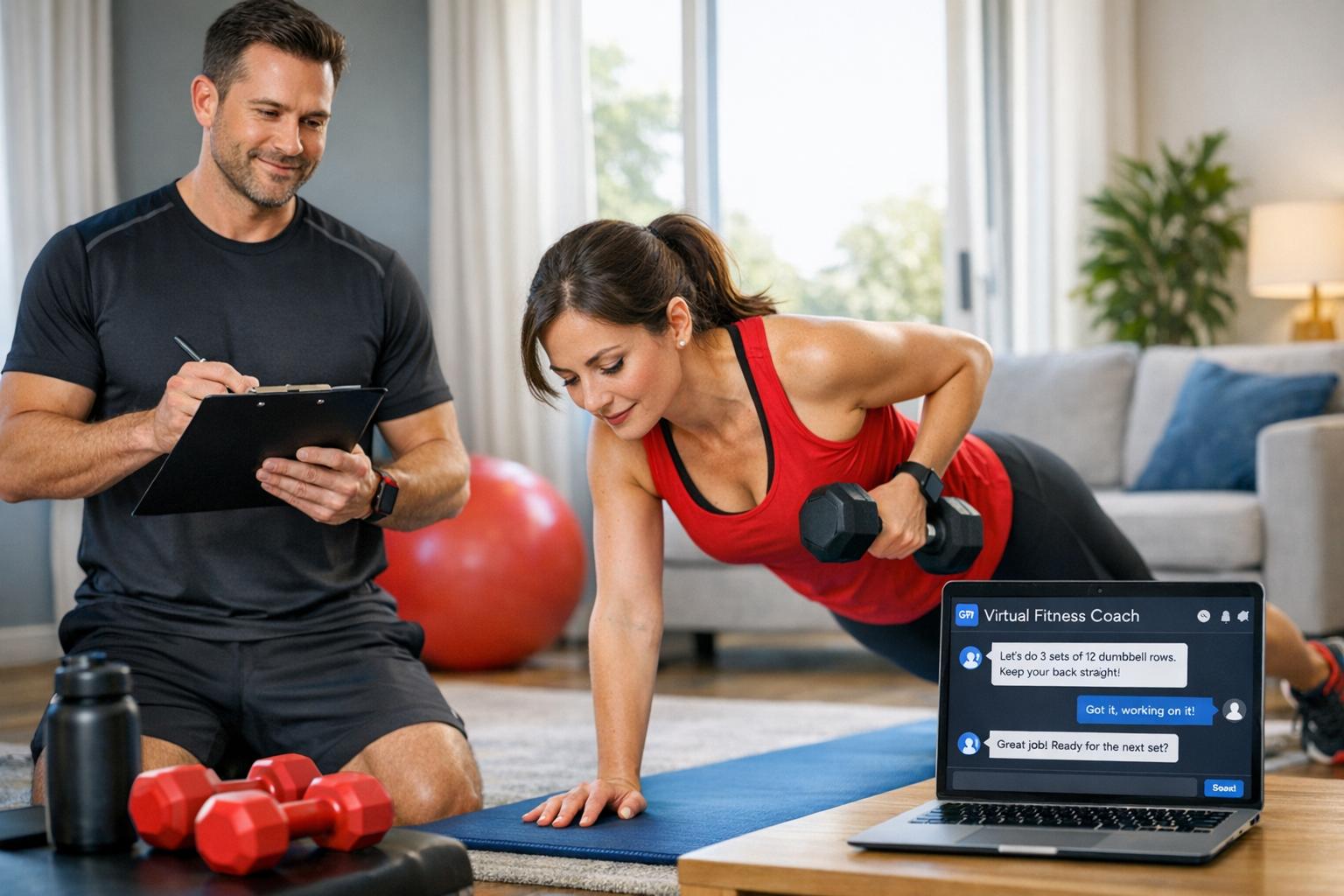
Can ChatGPT replace your fitness coach? Here’s the short answer: ChatGPT can help you save money and create workout plans, but it’s not a complete replacement for a human trainer. It’s great for beginners or self-motivated individuals who need basic guidance, quick exercise substitutions, or nutrition advice. However, it struggles with real-time feedback, personalized progression, and injury prevention.
Key Takeaways:
- Strengths: Free, flexible workout plans; 24/7 availability; useful for simple fitness goals.
- Weaknesses: No real-time form correction; incomplete plans; lacks accountability.
- Best Use Cases: Travel workouts, basic routines, or as a supplement to existing knowledge.
- Limitations: Can’t replace human expertise for advanced goals, injury rehab, or motivation.
ChatGPT is a helpful tool for fitness ideas and basic plans but works best when paired with your own knowledge or professional guidance.
The Problem: Why Traditional Fitness Coaching Doesn’t Work for Everyone
High Costs and Limited Access
One of the biggest hurdles to traditional fitness coaching is its steep price tag. Personal trainers typically charge between $50 and $300 per hour, with specialized trainers – like those focusing on rehabilitation or sports performance – charging even more, often ranging from $75 to $150 per session.
As Cori Ritchey, Fitness Editor at Men’s Health, aptly said: "Working out three times a week with a high-end trainer could cost more than Manhattan rent".
For many, these costs make regular coaching unattainable. Let’s break it down: working with a trainer three times a week at $75 per session adds up to a staggering $900 per month. On top of that, access to quality fitness coaching is unevenly distributed, with many areas lacking skilled professionals altogether. It’s no wonder that 62% of women cite the high cost of trainers as a significant barrier to maintaining regular exercise routines.
And even when people can afford coaching, the programs often fall short in addressing individual needs.
Generic Plans That Don’t Fit Individual Needs
Affordable alternatives like free online workout plans and budget-friendly fitness apps may seem like a good solution, but they often fail to deliver results. Why? Because these plans are typically one-size-fits-all and overlook critical factors like past injuries, access to equipment, and unique health conditions.
Research shows that AI-generated workouts often miss essential elements, resulting in incomplete or even unsafe training regimens. For example, some plans promote overly ambitious goals – like preparing for a marathon in just six weeks – which can lead to overuse injuries such as shin splints.
Jennifer Heimlich, a running coach, summed it up well: "A robot might have completed my prescribed workout and gotten results, but I’m far too human to pump out the same 12 bland moves with gusto – especially without a trainer to hold me to it".
Without personalization, these plans often fail to inspire the motivation or confidence needed to stick with them.
Staying Consistent Without Accountability
The final piece of the puzzle is accountability – or rather, the lack of it. Traditional coaching provides more than just a workout plan; it offers a human connection that helps you push through tough sets, adjust your program when needed, and stay on track. Generic plans and apps simply can’t replicate this level of support.
For instance, they don’t ask follow-up questions to differentiate between normal muscle soreness and a potential injury. And they certainly don’t adapt to your mental or physical state on a given day.
Beyond that, the mental effort of managing your own fitness program – balancing progressive overload, tracking nutrition, and tweaking your plan – can feel overwhelming. Without someone to hold you accountable, it’s all too easy to skip challenging exercises or abandon the plan altogether when life gets hectic. This lack of support is a major reason why so many people start fitness programs but fail to stick with them long enough to see meaningful results.
I tested ChatGPT as a personal trainer (real time camera workout experiment)
How ChatGPT Works as a Fitness Coach
ChatGPT offers a flexible and personalized alternative to traditional fitness apps and pricey personal trainers. Acting as a text-based fitness assistant, it tailors workout and nutrition plans based on personal details like age, weight, height, body fat percentage, fitness experience, available equipment, and goals. It uses the FITT model – Frequency, Intensity, Time, and Type – to design customized programs that fit individual needs.
Creating Custom Workout Plans
When crafting workout plans, ChatGPT thrives on detailed input. The more specific your information, the better the results. For instance, a July 2025 study published in BMC Public Health highlighted how GPT-4 created a 16-week fitness plan for a 24-year-old woman with a BMI of 25.1 and 30.2% body fat. After 15 interactions, the AI scored 12.80 out of 16 for personalization – slightly outperforming the average score of 11.53 achieved by three professional coaches.
Typically, ChatGPT combines compound movements like squats and presses with isolation exercises, depending on the user’s equipment and experience level. However, a January 2024 study revealed some gaps in its workout programming. While 90% of its exercise recommendations aligned with scientific principles, only 41% of the plans were fully detailed. Missing elements often included progression strategies, proper intensity levels, and adequate rest periods.
Offering Fitness and Nutrition Advice
Beyond workouts, ChatGPT provides guidance on nutrition. It can calculate your total daily energy expenditure (TDEE), set macronutrient goals (like daily protein intake), and explain fitness concepts such as progressive overload. One user shared their experience of losing 7 pounds of fat in just 33 days while following a "100-day cut" managed with ChatGPT. By regularly sharing meal logs, workout updates, and recovery data, they received tailored adjustments and meal suggestions from the AI.
Available 24/7, ChatGPT lets you ask fitness or nutrition questions anytime without fear of judgment. However, it’s crucial to understand its limitations. Ash James, Director of Practice and Development at the Chartered Society of Physiotherapy, points out:
"AI tools such as ChatGPT are trained on massive datasets… but they do not ‘know’ facts or have clinical judgment in the way a fitness or healthcare professional does".
While ChatGPT can offer general advice, it’s not a substitute for professional expertise – especially when dealing with injuries or rehabilitation.
Adjusting Plans Based on Progress
Once a plan is underway, ChatGPT adjusts based on your feedback. Unlike fitness apps that automatically track progress, ChatGPT relies on you to manually report your experiences. For example, you might say, "That weight felt too light" or "I was too tired to finish my sets", and the AI can tweak intensity, rest periods, or exercise selection accordingly.
In 2023, Mashable reporter Christianna Silva tested a 4-week ChatGPT-designed plan. It included a 2,000–2,200 calorie diet and 165 grams of protein daily. Over the month, she lost 2 pounds, gained an inch on her glutes, and lost an inch around her waist. The key to her progress was providing daily feedback, which allowed ChatGPT to make timely adjustments.
However, it’s important to note that ChatGPT can’t monitor fatigue, form, or injuries. For these aspects, you’ll need to rely on external resources or professional guidance.
4-Week Test: Using ChatGPT as a Fitness Coach
To explore whether ChatGPT could effectively replace a personal trainer, we conducted a four-week trial, comparing its workout plans to professional standards.
Test Setup and Method
The trial involved fitness experts like Cori Ritchey (CSCS and Fitness Editor at Men’s Health), Sam Hedditch (Personal Trainer), and Jennifer Heimlich (Running Coach). They provided ChatGPT with detailed information, including their strength levels (e.g., 10-rep maxes), available equipment, past injuries, and specific fitness goals. ChatGPT then generated customized four-week programs, offering options such as German Volume Training for muscle growth or strength routines tailored for marathon runners.
Over the 28-day period, participants followed the AI-generated workouts, tracked their adherence and results, and adjusted the plans in real time when equipment was unavailable or discomfort arose. These controlled conditions allowed us to evaluate ChatGPT’s effectiveness as a fitness coach.
Results and Key Metrics
The outcomes were mixed. For example, Christianna Silva, Senior Culture Reporter at Mashable, followed a plan with a daily intake of 2,000–2,200 calories and 165 grams of protein. Over the four weeks, she lost 2 pounds, gained an inch on her glutes, and lost an inch around her waist. In another case, ChatGPT’s body fat estimate for a user (13%) closely matched a professional DEXA scan result of 12.6%.
However, adherence dropped significantly after Week 2. Participants began skipping sets, swapping exercises (e.g., replacing front squats with back squats), and shortening workouts due to time constraints. ChatGPT earned a 4 out of 5 for creating initial workout plans but only a 1 out of 5 for tracking long-term progress, as its memory became unreliable after one to two weeks. While about 90% of the exercise selections were accurate, only 41% of the programs provided clear guidance on intensity, volume, and progression.
Planned vs. Actual Results
The table below highlights the gap between intended goals and actual outcomes during the trial:
| Week | Planned Activity/Goal | Actual Outcome/Adherence | Intensity |
|---|---|---|---|
| Week 1 | Follow prescribed splits (e.g., 10×10 GVT) | Completed all sets; workouts averaged 90 minutes instead of the 45–60 minute target | High; "legs were shot" |
| Week 2 | Apply progressive overload, adding ~5.5 lbs (2.5 kg) to lifts | Skipped sets and swapped exercises due to time and equipment issues | Moderate; "honeymoon phase" |
| Week 3 | Maintain volume and intensity | Motivation dropped; harder exercises replaced with easier alternatives | Low; "losing steam" |
| Week 4 | Final progression and peak volume | Adjusted for knee pain; ChatGPT suggested R.I.C.E. and physical therapy | Variable; hindered by injury |
One major challenge was the extended workout duration. Even when testers requested shorter sessions, gym time consistently stretched to around 90 minutes. Additionally, ChatGPT’s exercise sequencing often placed machine-based moves like leg presses before heavy free-weight exercises like Romanian deadlifts. This increased fatigue and raised the risk of injury during the trial. As Cori Ritchey commented:
"I was in the gym for nearly an hour and a half for the first leg day – a luxury I can’t afford with my workaholic lifestyle".
What ChatGPT Does Well and Where It Falls Short
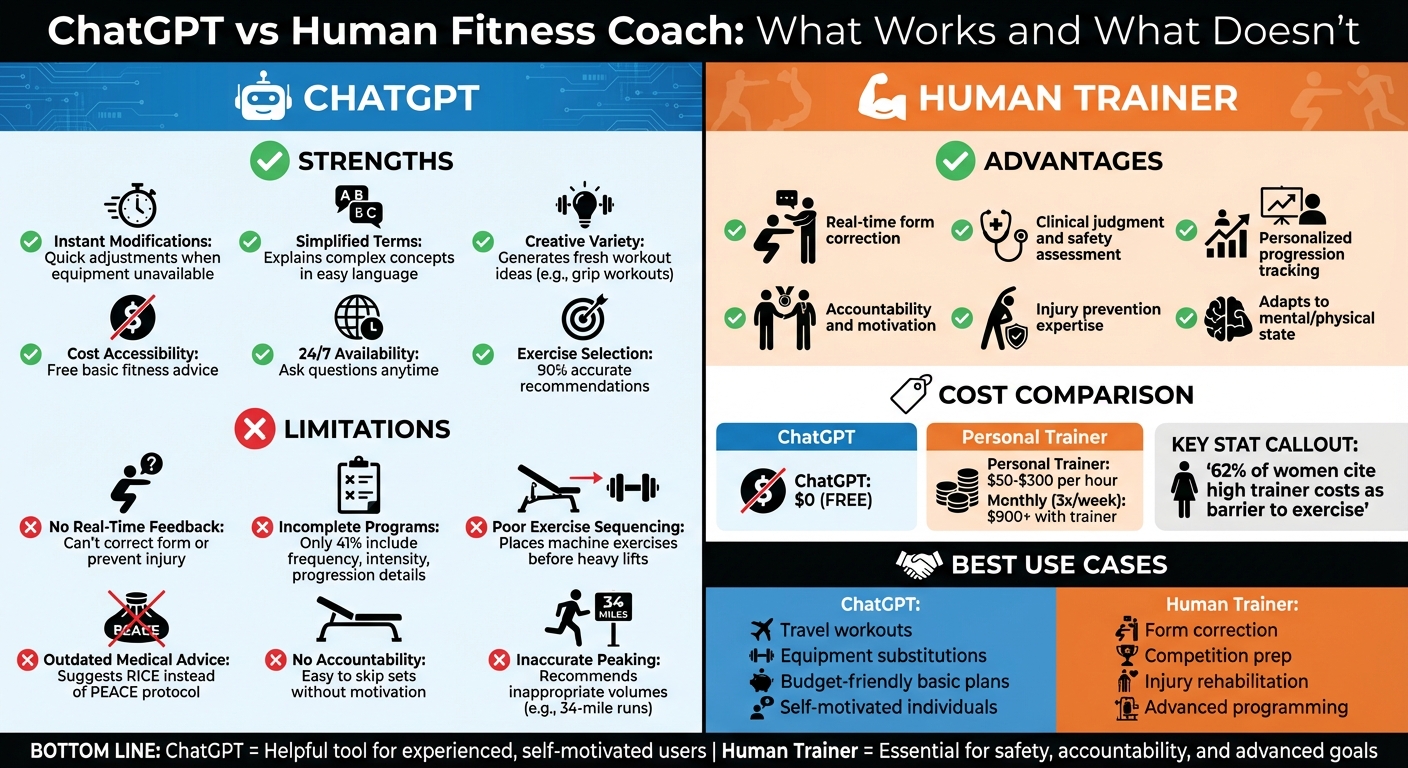
ChatGPT vs Human Fitness Coach: Strengths, Weaknesses, and Best Use Cases Comparison
After a four-week trial, here’s a breakdown of ChatGPT’s strengths and weaknesses when it comes to fitness guidance.
Strengths: What Works
ChatGPT shines in its ability to deliver quick, free, and personalized fitness advice. During the trial, it effectively recommended compound movements like squats and chest presses, complete with appropriate sets and reps for muscle growth. Cori Ritchey, C.S.C.S., shared:
"The exercise selection was fine; ChatGPT assigned me compound movements like squats and chest presses with some efficient isolation moves. It doesn’t get too complicated or unnecessarily fancy."
One standout feature is its ability to provide instant exercise substitutions. For instance, when testers couldn’t access a barbell bench press due to a crowded gym, ChatGPT immediately suggested alternatives using dumbbells. It also simplifies fitness jargon, explaining terms like "anabolic potential" in plain language that even a middle schooler could understand.
For beginners or those seeking variety without the cost of a personal trainer, ChatGPT offers a practical starting point.
| Feature | Benefit | Test Evidence |
|---|---|---|
| Instant Modifications | Quick adjustments when equipment is unavailable or time is limited | Suggested dumbbell alternatives for a barbell bench press |
| Simplified Terms | Explains complex fitness concepts in easy-to-understand language | Defined "anabolic potential" at an 8th-grade reading level |
| Creative Variety | Prevents monotony by suggesting fresh workout ideas | Generated a "grip workout" with towel pull-ups and plate pinches |
| Cost Accessibility | Provides basic fitness advice at no cost | Created a postpartum walking and pelvic floor plan for a new mother |
These strengths highlight ChatGPT’s flexibility and accessibility for users looking to enhance their fitness routines.
Limitations: What Doesn’t Work
Despite its strengths, ChatGPT has some notable shortcomings, particularly in areas where human expertise is essential. One major drawback is its inability to provide real-time feedback, which increases the risk of injury due to poor form. Celebrity trainer Aimee Victoria Long explained:
"Where ChatGPT loses out to having a trainer is that it can’t correct form, it can’t ask you for feedback… and it can’t assess if you’re using the correct resistance."
The AI also struggles with specialized programming. For example, it once recommended a 19-mile run the day before a marathon and suggested a 34-mile training run for an intermediate runner – both highly inappropriate. A study from January 2024 found that while 90% of ChatGPT’s exercise advice was accurate, only 41% of its programs included critical details like frequency, intensity, and progression.
Another issue is outdated medical advice. During testing, ChatGPT suggested the outdated "RICE" method for injury recovery instead of the updated "PEACE" protocol. Ash James, Director of Practice and Development at the Chartered Society of Physiotherapy, warned:
"AI tools such as ChatGPT… do not ‘know’ facts or have clinical judgment in the way a fitness or healthcare professional does."
Finally, the lack of accountability is a recurring problem. Without the motivational push of a human trainer, testers found it easier to skip sets or cut workouts short. Personal trainer Kristie Larson put it bluntly:
"It doesn’t account for humanity at all. Sure, it might write a very good training plan – if you were also a machine."
| Issue | Impact | Workaround |
|---|---|---|
| No Real-Time Feedback | Increases risk of injury from improper form | Use mirrors or record your sets for comparison with online demos |
| Inaccurate Peaking | Recommends inappropriate workout volumes | Cross-check AI advice with expert resources |
| Lack of Personalization | May lead to repetitive workouts or missed progressions | Manually adjust weights weekly (e.g., add 2.5–5 lbs) |
| Poor Exercise Order | Can lead to fatigue during key compound lifts | Reorganize workouts to prioritize exercises like squats and deadlifts |
When to Use ChatGPT and How to Get the Best Results
Best Scenarios for Using ChatGPT
ChatGPT is particularly useful for those who already have a solid understanding of fitness and are looking for fresh ideas or guidance. As registered dietitian Crystal Zabka Belsky explains:
"it offers a sense of accountability and access for highly motivated people".
This means it works best for individuals who are self-driven and know how to navigate their fitness routines.
The AI excels in specific scenarios. For instance, it can help you create a hotel room workout while traveling, suggest alternatives when your gym is packed, or guide you through postpartum recovery. It’s been noted for its recommendations on pelvic floor exercises and gentle movements, while cautioning against high-impact activities until you’re cleared by a medical professional. For those on a tight budget, ChatGPT serves as a cost-effective option compared to hiring a personal trainer.
Fitness editor Cori Ritchey, C.S.C.S., puts it this way:
"Maybe [it’s a fitness hack], if you’re very experienced, extremely self-motivated, and if you understand workouts enough to make your own tweaks".
However, if you need someone to correct your form, push you through tough sets, or design a program for competition prep, sticking with a human coach is the smarter choice.
Once you’ve identified when ChatGPT fits into your fitness journey, the key to success lies in providing clear, detailed instructions to get the most out of your workouts.
How to Write Better Prompts and Track Progress
To get quality advice from ChatGPT, the details you provide matter. Vague prompts lead to generic responses, so include specifics like your height, weight, age, fitness level, any injuries or medical conditions, and the equipment you have access to – whether it’s a full gym setup or a single 44 lb kettlebell at home.
One user shared that they lost a couple of pounds and gained an inch on their glutes over four weeks, thanks to providing detailed input upfront. Be clear about your goals, too. Instead of saying "get fit", try something like "create a 12-week program to increase my squat by 20 lbs" or "suggest EMOM workouts for grip strength using a pull-up bar." Using terms like EMOM, Tabata, or progressive overload helps structure your training. If the AI’s response feels too long or overly detailed, you can ask for "just sets and reps in a table format" to make it easier to follow during your workout.
That said, always double-check unfamiliar exercises online. ChatGPT has been known to suggest movements that don’t actually exist, and attempting them could lead to injury. Track your progress through photos, body measurements, strength improvements, and how your clothes fit. Keeping all your fitness-related conversations in a single chat thread allows the AI to remember your preferences and history, which can help refine your program over time. At the end of each week, review your progress by noting specifics like your weight, the number of workouts completed, energy levels, and any challenges you faced. This feedback loop ensures better results and adjustments moving forward.
Conclusion: Should You Use ChatGPT as Your Fitness Coach?
Based on our 4-week trial, ChatGPT works best as a fitness tool rather than a complete replacement for human trainers. If you’re someone with gym experience and a solid grasp of proper form and training principles, it can be a great resource for brainstorming new workout ideas, creating routines for travel, or tweaking plans when equipment is unavailable. Plus, it’s a more budget-friendly option compared to hiring a personal trainer.
ChatGPT shines in certain areas. For example, it provided valuable advice for postpartum recovery, focusing on pelvic floor exercises and emphasizing the importance of medical clearance before high-impact activities. Research also suggests that ChatGPT can create personalized plans that rival those of experienced coaches, though human trainers still lead when it comes to safety and effectiveness.
That said, our trial revealed some limitations. While ChatGPT can design creative and accessible workouts, it falls short in offering real-time feedback and precision. It can’t monitor your form or ensure your safety during exercises. Studies found that its exercise recommendations were only 41% complete in addressing key factors like frequency, intensity, time, and volume. There were also instances where it suggested exercises that don’t exist or recommended excessively high training volumes for marathons.
Think of ChatGPT as a helpful starting point, not the ultimate authority. Use it to generate ideas, but double-check any unfamiliar advice with trusted fitness resources or professionals. As certified personal trainer Jill Goodtree puts it:
"ChatGPT cannot keep you safe".
FAQs
Can ChatGPT create effective workout plans tailored to individual fitness goals?
ChatGPT can offer simple workout ideas aimed at general fitness goals, like boosting strength or improving endurance. But when it comes to more advanced or highly specific objectives – such as marathon training or targeting muscle growth in specific areas – its advice may fall short in terms of detail and precision.
While it’s great for sparking ideas or providing a starting point, ChatGPT doesn’t take into account personal factors like medical history, physical limitations, or tracking your progress over time. For a truly personalized plan, it’s best to pair ChatGPT’s suggestions with advice from a professional coach or fitness expert.
What are the potential risks of relying on ChatGPT for fitness advice without professional input?
Using ChatGPT as your only fitness coach comes with certain risks. Its advice is drawn from general knowledge, not tailored medical or fitness expertise. This means the workout plans it suggests might not suit your specific health needs, potentially leading to injuries, overtraining, or even burnout.
Another concern is that ChatGPT doesn’t always adhere to established medical guidelines or account for individual conditions like hypertension, diabetes, or joint problems. Without professional guidance, you might unknowingly perform exercises that aren’t safe, ignore your own physical limits, or skip critical health precautions. Unlike a human coach, ChatGPT can’t offer empathetic support or adjust your plan in real time based on signs like fatigue or discomfort. Because of these limitations, AI fitness tools are best used as a complement to professional advice, not a substitute.
How can I make sure a ChatGPT-created workout is safe and effective?
To make sure a ChatGPT-generated workout is both safe and effective, think of it as a starting point, not the final word. The workout should match your fitness level, health history, and any medical conditions you might have. Before diving into a new routine, it’s always smart to check in with a doctor or a qualified health professional.
Pay attention to key training principles to get the most out of your workout. Start with a 5–10 minute warm-up – something like brisk walking or dynamic stretches works well. Use a progressive overload strategy, which means gradually increasing weight, reps, or workout duration over time. Don’t forget to schedule rest weeks every 4–6 weeks to let your body recover. After your workout, cool down with static stretching to help maintain flexibility. If you’re unsure about your form, look up reliable fitness resources or get a certified trainer to guide you.
Keep your plan adaptable by tracking your progress. Write down details like the weights you use, the number of sets and reps, and how you feel after each session. Adjust your plan based on this feedback, and stop immediately if you feel pain or discomfort. For the safest and most effective results, combine ChatGPT’s suggestions with advice from a fitness professional to fine-tune the program and steer clear of potential risks.