
Improving swing speed is achievable for senior golfers with the right approach. Here’s how you can add power and distance to your game:
- Measure Your Swing Speed: Use an affordable radar device (e.g., Sports Sensors Swing Speed Radar) to establish a baseline and track progress. Even a 1 mph increase can add 2–3 yards to your drive.
- Strength and Mobility Training: Combine exercises like dumbbell swings, squat jumps, and hip thrusts with mobility routines to increase power and range of motion. Apps like Fit For Golf offer tailored programs for seniors.
- Overspeed Training: Use lighter clubs to train your body to move faster. This method can boost swing speed by 5% or more over time, adding significant distance to your drives.
- Adjust Swing Technique: Lengthen your downswing path, improve rotation, and fine-tune timing for better energy transfer. Small changes, like flaring your feet or lifting your lead heel, can make a big difference.
- Core Strength Development: Medicine ball exercises, such as slams and rotational throws, help build the rotational power essential for a strong swing.
With consistent effort – just 15–20 minutes a few times a week – you can add 5–10 mph to your swing speed in 6–8 weeks. Tools like Fit For Golf simplify the process by offering structured plans and progress tracking. Start today to hit longer, straighter drives and improve your scores.
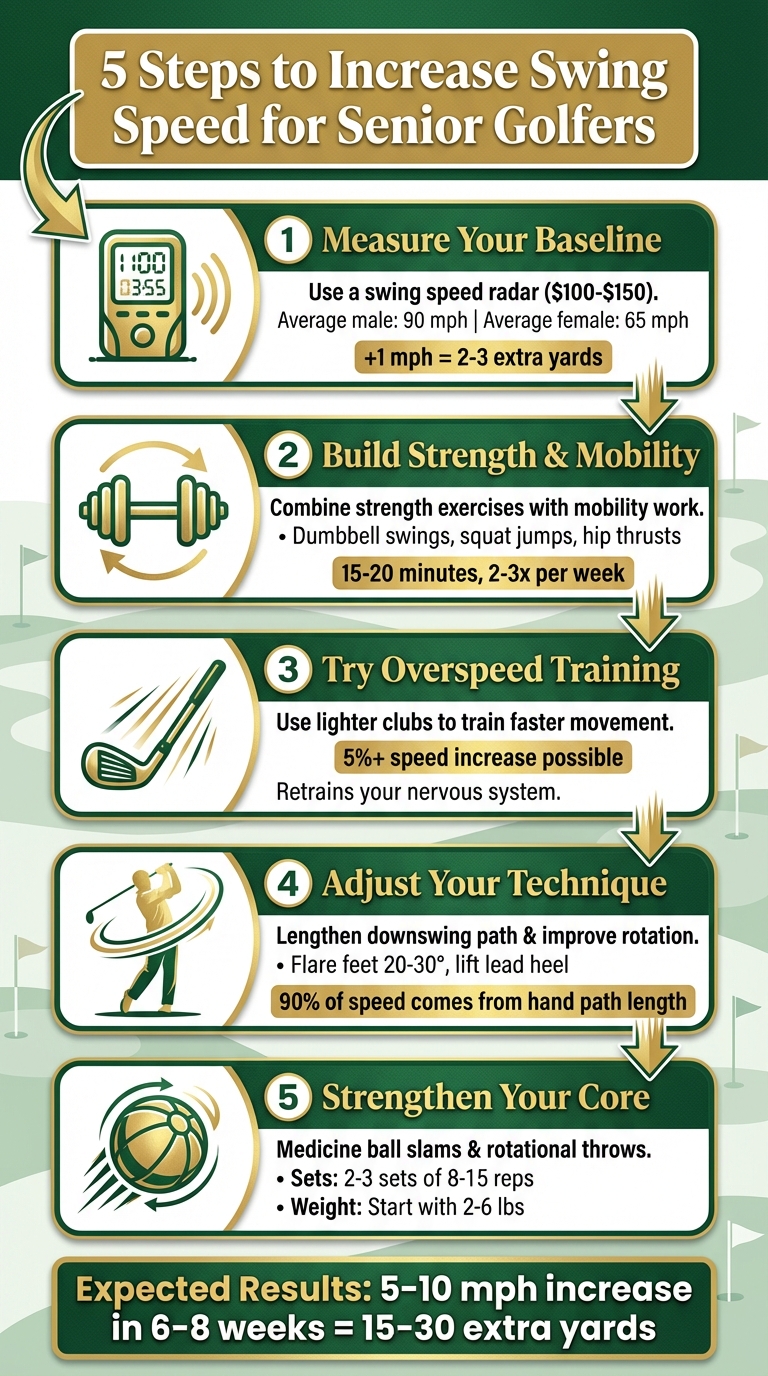
5-Step Guide to Increasing Golf Swing Speed for Seniors
3 Moves That Give Senior Golfers More Speed & Power (works for any age too)
Measuring Your Current Swing Speed
Before diving into training, it’s important to establish your starting point. Measuring your swing speed not only gives you a baseline but also helps track your progress over time. Plus, knowing your clubhead speed is key for choosing the right shaft flex – whether that’s Senior (A-flex), Regular, or Stiff – and for figuring out which swings deliver the best results.
Here’s the good news: you don’t need to spend a fortune to get started. Most swing speed radars cost between $100 and $150 and use Doppler radar technology to measure your clubhead velocity. Many of these devices even support indoor "air swings", so you can practice regardless of the weather.
How to Use Swing Speed Radars
To get accurate readings, set your radar device at a 45° angle about 6–12 inches from the tee.
Here are a few affordable swing speed radars available in the U.S.:
- Sports Sensors Swing Speed Radar (rated 4.4/5): Known for its accuracy and durability, with users reporting years of reliable performance.
- PRGR Black Pocket Launch Monitor (rated 4.3/5): Goes beyond swing speed by also measuring ball speed and smash factor, offering excellent value.
- RYP Radar (rated 4.1/5): Features voice feedback, letting you hear your results without needing to move – especially convenient for senior golfers.
"All you really need to make progress is your driver and, hopefully, some sort of radar device to measure your speed. That’s it."
- Jaacob Bowden, PGA of America Coach and Trainer
Most radars work indoors and don’t require a ball, making them perfect for year-round use. If convenience matters to you, look for models with voice feedback or remote controls to minimize bending and maximize comfort.
Recording Your Starting Numbers
Take multiple readings to establish your baseline. Even a small increase – just 1 mph in clubhead speed – can translate to roughly 3 extra yards off the tee. Small gains like this can add up over time.
Make sure to log your initial numbers, including the date, swing speed, and any drills you’re using. Tracking these stats weekly or monthly will help you identify trends and evaluate the effectiveness of your training.
"Take ownership of your strength & power training, take wherever you are now as your starting point, and embark on a plan for improvement."
- Mike Carroll, S&C Coach and TPI Fitness Level 2 Certified
For perspective, the average male amateur golfer swings at about 90 mph, while the average female swings closer to 65 mph. A 70-year-old man typically drives between 200 and 220 yards. Understanding where you stand compared to these benchmarks can help you set realistic goals and track your progress.
With your baseline recorded, you’re ready to move on to exercises that build strength and mobility.
Building Strength and Mobility with Fit For Golf

Once you’ve nailed down your baseline swing speed, the next step is to focus on strengthening your body and improving mobility. The Fit For Golf app is a great tool for golfers looking to add distance without spending endless hours in the gym. It features a "Program Matcher" that tailors workouts to your age and fitness level, making it especially helpful for senior golfers. Plus, you can try it out with a 7-day free trial, and there’s a 20% discount available with the code OFFSEASON-26.
This method combines strength and mobility to help you extend your swing arc and generate more power. Research backs this up, showing that linear work – essentially the hand path length multiplied by the average force – accounts for 90% of the variation in clubhead speed. To put it simply, you need both flexibility (mobility) and the muscle power to accelerate through your swing (strength). The app tackles both areas at the same time.
"A more mobile body doesn’t automatically produce more speed, but it does set us up nicely. When a golfer has sufficient range of motion in some key areas, such as the hips, thoracic spine, and shoulders, it enables a nice long hand path."
- Mike Carroll, Founder, Fit For Golf
The app also includes a TPI Self-Assessment Guide, which uses video demonstrations to evaluate your mobility in key areas like your hips, thoracic spine, and shoulders. Identifying these limitations can reveal why your swing might be falling short. For instance, restricted hip internal rotation can prevent your pelvis from rotating effectively, while limited thoracic rotation might force you into an "arms-only" swing, reducing power.
Below, check out how the Fit For Golf app offers targeted exercises to boost both your strength and mobility, directly enhancing your swing speed.
Strength Exercises for More Power
Building muscle strength is essential for generating more force along your hand path, which translates to greater power at impact. The Fit For Golf app focuses on exercises that improve both strength and explosiveness.
Some key exercises include:
- Dumbbell swings: Develop golf-specific power.
- Squat jumps: Build lower body explosiveness.
- Hip thrusts: Strengthen the glutes while enhancing mobility.
- Single-arm rows: Improve shoulder stability.
The app’s workouts are designed to adapt to your fitness level and include year-round programs, even for "super seniors." This gradual adjustment helps reduce the risk of injury while building the strength you need for a powerful swing.
"Strength training through the full range of motion at a joint is extremely good for mobility. You can get stronger and more mobile at the same time. A win-win and huge time saver."
- Mike Carroll, Founder, Fit For Golf
Mobility Exercises for Better Movement
While strength gives you power, mobility ensures your swing is as efficient as possible. Think of mobility work as extending your runway – the longer the runway, the more speed you can build before impact.
The app’s "Golf Warm-Ups & Mobility" section offers quick routines (5–10 minutes) that require minimal equipment and can be done daily or before a round. For instance, the "Dynamic Warm-Up #1" is an 8-minute routine used by PGA Tour pros to prepare their nervous system and joints for speed training. Making this a daily habit helps maintain and improve mobility over time.
Another standout feature is the "GolfFlex" routine, which focuses on increasing hand path length by improving rotation in your hips, thoracic spine, and shoulders. For many senior golfers, limitations in these areas can shorten the swing arc, reducing overall power.
Using Overspeed Training to Increase Swing Speed
Overspeed training is a method that uses lighter clubs to train your neuromuscular system to move faster. By reducing the weight of the club, your body learns to operate at speeds beyond its usual limits. This technique can be particularly effective for senior golfers, as it targets the fast-twitch muscle fibers that naturally slow down with age. Essentially, it helps retrain your body to maintain speed, even as you get older. Research backs this up – seniors with an average age of 70 saw over a 5% increase in clubhead speed through consistent overspeed training, with one participant, aged 89, still achieving similar gains.
"Overspeed Training works by making your body move faster than normal during the training, gradually causing the brain to remember this faster speed."
The benefits are clear. For every additional 1 mph of swing speed, you can expect an extra 2–3 yards of distance. One study on recreational golfers found that overspeed training led to a 5% increase in driving distance, a 10% boost in accuracy, and an average reduction of 2.7 strokes per round. Some golfers even gain up to 20 yards in as little as six weeks. This approach not only enhances your neuromuscular response but also sets the stage for more advanced performance improvements.
The Science Behind Overspeed Training
Your brain naturally limits your speed based on what it considers "normal." Overspeed training challenges this by teaching your nervous system to accept faster movements as the new standard. When you swing a lighter club, the reduced resistance allows your body to move faster than it would with a standard club. After repeated practice, your brain adjusts and adopts this quicker motion as its baseline.
This is especially valuable for senior golfers, as aging often leads to a gradual decline in swing speed. Without intervention, many golfers notice their drives getting shorter with each passing season. Overspeed training helps counteract this by keeping your nervous system sharp and engaged with fast movements. Once you’ve achieved initial speed gains, maintaining them is crucial. Typically, one session per week is enough to prevent losing progress over time.
The process is simple: dedicate 15 minutes to overspeed training three times a week. Seniors, however, should allow for 48 to 72 hours of rest between sessions to ensure proper recovery, especially if they’re playing rounds of golf in between. Always start with a dynamic warm-up to prepare your muscles and joints for the high-speed swings. To make this easier, the Fit For Golf app includes overspeed training as part of its structured programs.
Adding Overspeed Training with Fit For Golf
The Fit For Golf app offers a dedicated "Swing Speed Training" section, making it easy to integrate overspeed protocols into your routine. Just like the strength and mobility exercises in the app, warm-ups and gradual progression are key to safe and effective training. The program walks you through a structured process, starting with lighter tools and progressing to air swings, foam ball drills, and eventually real-ball practice.
One standout feature is the app’s "Dynamic Warm-Up #1", an 8-minute routine designed to prime your muscles and nervous system for high-speed swings. This warm-up is essential before every speed session. The app recommends beginning with 2 to 3 sessions per week, performing 15 high-intensity swings per session. Rest for 20–30 seconds between swings and take 2–3 minutes between sets to ensure quality performance.
After completing a 10-week intensive program, the app transitions you into a maintenance phase, reducing the frequency to one high-intensity session per week. This approach allows your body to recover while preserving the speed gains you’ve achieved. To keep you motivated, the app includes feedback tools that track your progress and gamify your training. By ensuring each swing is performed with maximum intent, you stay focused on your ultimate goal: increasing your swing speed.
Adjusting Your Swing Technique for More Speed
Building strength and practicing overspeed drills are great for a faster swing, but the real magic happens with your swing mechanics. How you move determines how well you transfer all that power. Many senior golfers unintentionally slow themselves down by shortening their swing arc or relying too much on their arms. Research highlights that 90% of the variability in clubhead speed comes from the distance your hands travel during the downswing. So, making small tweaks – like adjusting foot placement, extending your hand path, or fine-tuning your downswing sequence – can lead to impressive results. For example, a 7 mph boost in clubhead speed could add about 20 yards to your drive, and a proper wrist release might tack on 25 yards or more. These changes work hand-in-hand with your strength training, ensuring that every ounce of power is used efficiently.
Creating a Longer Swing Path
Your downswing is a lot like a runway for an airplane – the longer it is, the more time you have to build speed before liftoff. The same principle applies to your hand path. A longer hand path during the downswing allows you to apply more force to the club, which directly increases clubhead speed.
"A longer hand path gives you more time and distance to apply force to the club, increasing the total impulse delivered to it… Think of it like having a longer runway to accelerate down."
- Mike Carroll, Founder, Fit For Golf
To extend your hand path effectively, focus on improving your body rotation rather than just reaching back with your arms. A simple yet powerful adjustment is to flare both feet outward by 20–30 degrees. This change unlocks your hip rotation, making it easier to achieve a full torso turn. For instance, flaring your back foot helps create a deeper backswing, while flaring your front foot allows your hips to clear more easily at impact. Another tip? Let your lead heel lift off the ground during the backswing. This move helps your pelvis and torso rotate farther, giving your hands a longer path to travel and unlocking more speed.
Instead of just lifting your arms, focus on turning your chest and shoulders until your back faces the target. Many instructors emphasize this full-body rotation with the phrase "torso, torso, torso". To practice, try the Swoosh Drill: swing an upside-down driver and listen for the loudest "swoosh" at impact. This sound confirms you’re accelerating in the right zone with maximum hand speed.
Improving Your Timing and Tempo
Once you’ve lengthened your hand path, the next step is syncing your movements for peak efficiency. Speed isn’t just about swinging harder – it’s about swinging smarter. When your timing is spot-on, energy flows smoothly from your body to the clubhead. But poor timing? That creates tension, limits movement, and slows you down. Interestingly, many golfers find that swinging a little slower during the backswing allows for a bigger turn and better positioning, ultimately leading to higher clubhead speed at impact.
"When [Raymond Floyd] wanted to hit it farther he swung slower. This allowed him to make a bigger turn. When trying to add speed you typically will swing faster which will tighten muscles up, shorten the swing and throw off the timing."
- Dean Alexander, PGA Master Professional
The key to powerful timing lies in your downswing sequence. To generate speed, start your downswing with your lower body while your upper body is still completing the backswing. This creates a whip-like effect. A subtle weight shift onto your lead foot just before finishing your backswing ensures your lower body leads the downswing, a crucial move for maximizing clubhead speed. For senior golfers who may not rotate as quickly as they once did, wrist release timing becomes even more important. In fact, about two-thirds of clubhead speed comes from the release of your wrists.
Keep your grip pressure light and your jaw and shoulders relaxed to avoid tension that could throw off your tempo. For extra help, the Fit For Golf app offers drills designed to fine-tune your tempo and downswing sequence. By combining these timing improvements with your longer hand path, you’ll get the most out of your strength and speed training.
Medicine Ball Exercises for Core Strength
A strong core is key to transferring power from your lower body to the clubhead, ensuring no energy is wasted during your swing. Without this stability, your swing can lose efficiency, cutting down your distance. Medicine ball exercises are a great way to build this strength because they closely mimic the rotational movements needed for a powerful swing. Plus, they help maintain those fast-twitch muscle fibers that are essential for generating speed.
For safety and effectiveness, start with a lighter ball – something in the 2–6 lb range is ideal. Focus on mastering your form before moving on to a heavier ball.
Here are a few exercises to include in your routine:
- Medicine Ball Slams: Lift the ball overhead and slam it down with force. This movement engages your core and builds explosive power.
- Rotational Wall Throws: Stand sideways to a wall, load your back hip, and throw the ball against the wall as hard as you can. This targets the rotational strength crucial for your swing.
- Sit and Throw: Lie on your back with your feet against a wall, sit up quickly, and throw the ball forward. This focuses on your abdominals and lower back.
Each of these exercises trains your muscles to produce the explosive force needed during your swing.
"Core strength is crucial for golfers, as it helps increase power, stability, and strength in the golf swing."
- Thor Parrish, PGA Coach and Founder, Thunder Performance
Aim for 2 to 3 sets of 8 to 15 repetitions for each exercise. Be sure to work both sides evenly to avoid muscle imbalances. Remember, if any movement causes discomfort, stop immediately. The goal is to build power safely, not to risk injury. By strengthening your core with these exercises, you’ll set yourself up for faster, more powerful swings.
For more guidance on how to incorporate these exercises into a complete workout plan, check out the Fit For Golf app. It offers routines specifically designed for senior golfers who want to improve their swing speed.
Monitoring Your Progress and Setting Goals
Tracking Your Results in Fit For Golf
If you’re not measuring your progress, it’s tough to know if your training is paying off. The Fit For Golf app simplifies this process by offering tools to monitor your physical improvements and swing speed over time.
The app includes video demonstrations and benchmarks to help you track mobility gains. Improved mobility – especially rotational mobility – can extend the "runway" for your hands, leading to faster swing speeds.
It also lets you log swing speed data from launch monitors or radars. This kind of feedback is invaluable. When you see your numbers improve, it naturally motivates you to push harder during training. Mike Carroll, the founder of Fit For Golf, emphasizes this point:
"Practice what you want to get better at with a high level of intent and feedback. For speed training, a radar is essential. It is akin to having a stopwatch for measuring sprint times. Without it, you are guessing." – Mike Carroll, Founder, Fit For Golf
By leveraging these tools, you can set measurable goals and work toward consistent improvements.
Setting Achievable Speed Goals
For senior golfers, increasing swing speed by 5–10 mph is an attainable goal with focused training. To put that into perspective, every 1 mph boost in swing speed adds about 2–3 yards to your driving distance. A 7 mph increase could mean an extra 20 yards off the tee.
The key is to set realistic, incremental targets. For example, aim to add 5+ mph to your swing speed over an 8–12 week period using a Fit For Golf program. The app’s Program Matcher feature ensures you’re following a plan suited to your fitness level and goals. Plus, speed training doesn’t require a huge time commitment – sessions typically take just 15–20 minutes, 3–4 times per week.
Keep an eye on both your practice and on-course speeds. If there’s a gap of more than 5–7 mph between the two, it might signal hesitation during your rounds. In these cases, try "speed priming" swings at the tee box to activate your nervous system before hitting your drive.
Ready to get started? Try the Fit For Golf app’s 7-day free trial and use code OFFSEASON-26 for 20% off.
Conclusion
Senior golfers looking to increase their swing speed can focus on three key areas: building strength, improving mobility, and incorporating overspeed training. Strength training enhances the power you can deliver to the club, while mobility exercises help create a wider and more effective swing arc, giving you more room to accelerate through impact. Overspeed training, on the other hand, pushes your nervous system to adapt to faster movement patterns, helping you break through speed plateaus. Together, these approaches work to counterbalance the effects of aging and keep your game sharp.
"Club head speed is extremely trainable, and worthy of serious attention if you are a golfer committed to improving your scores".
- Mike Carroll, founder of Fit For Golf
By combining these methods, you can see measurable improvements in your swing speed. To get started, consider using the Fit For Golf app for customized programs and progress tracking. You can even try it free for 7 days and use the code OFFSEASON-26 for 20% off.
With just 15–20 minutes of focused effort, 2–3 times per week, you could gain 5–8 mph in swing speed within 6–8 weeks. Using a radar device to track your progress not only provides valuable feedback but also keeps you motivated to stay on course.
FAQs
What’s the best way for seniors to measure their swing speed at home?
Measuring your swing speed at home is simpler than it sounds, and all you need is your smartphone and a good app. Many swing speed apps take advantage of your phone’s accelerometer to measure club-head speed in miles per hour. To get started, just secure your phone to the club using a rubber band or a mount, then swing as you normally would. Make sure you’re in a safe spot, like your backyard or a garage with a hitting net. After each swing, the app will show your speed.
For more detailed tracking, consider using tools like the Fit For Golf app. This app lets you log your swing speed, monitor your progress, and even access personalized training tips designed to help you increase your speed by 5–10 mph. Reassess every 4–6 weeks to track improvements and tweak your training plan as needed.
What are the best exercises for senior golfers to increase swing speed?
Increasing swing speed for senior golfers requires a mix of strength, flexibility, and balance. To build strength, try exercises like dynamic torso rotations, medicine ball throws, and resistance band drills that mimic your swing. Lower-body power moves, such as squat jumps or skater hops, can also boost your drive. Pair these with mobility exercises – like hip and shoulder stretches – to help you achieve a more complete turn. Balance drills are equally important, as they improve your ability to transfer energy efficiently to the clubhead.
For a more guided plan, the Fit For Golf app is a great resource. It offers workout programs tailored specifically for senior golfers, complete with video demonstrations and progress tracking. The app focuses on building speed and power safely, ensuring you don’t put unnecessary strain on your joints. By combining strength training, mobility work, and regular practice, you can gradually increase your swing speed and improve your game.
How can senior golfers increase their swing speed effectively?
Senior golfers looking to add some zip to their swing can benefit from overspeed training. This method trains the brain to move the body faster by focusing on speed-based movements. Using lighter equipment or engaging in speed-specific drills helps activate and strengthen fast-twitch muscle fibers, which tend to weaken with age. The result? Improved swing tempo and increased clubhead speed – all without putting unnecessary strain on your joints or muscles.
For those seeking extra guidance, the Fit For Golf app is a great resource. It provides overspeed drills tailored for senior players, along with exercises to improve mobility, strength, and flexibility. By following the app’s structured training plans, golfers can safely work on their swing speed, add distance to their shots, and stay confident out on the course.